One platform for the whole building — the resident's phone, the committee's books, and the gate house desk. Maintenance and dues, visitors and vehicles, complaints and work orders, notices and amenities: thirty-six modules, and you switch on the ones your society actually uses.

A society is not one job. The person paying their dues, the treasurer chasing them and the guard on the gate need different things — so they get different surfaces, over one set of records.
Everything about your own flat, and nothing about anybody else's.
Run the society without the spreadsheets, and without handing everyone the keys.
A console for the people at a desk, because a guard types a plate faster than they tap one.
Forty-three modules, from the lift that needs servicing to the housie night on Saturday. Turn on the ones your society uses; the committee decides who runs each.
Who lives here, who runs it, and what it has decided.
The register of the place: blocks, flats and unit types, and who holds each one as owner, tenant or care taker. A flat can have several owners, and everything else hangs off this.
Core Module
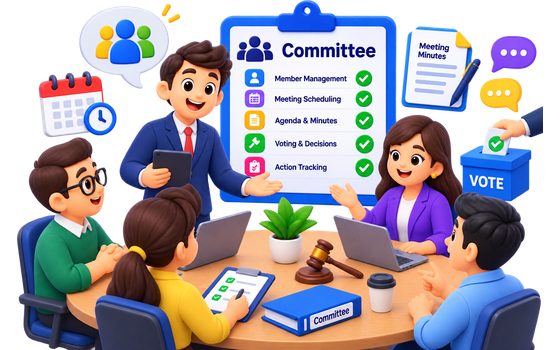
Define the committee and tick what each role may run — a treasurer who keeps the banks and the bills, a secretary who keeps the minutes. The tick is the permission.
Governance
Notices, agendas, minutes and the society's bye-laws, kept where the flats can reach them. Guards and technicians work here; the society's papers stay with its members.
Governance
Water off Tuesday, nine to one. A notice goes to the whole society, to owners, to tenants or to a single block, and arrives as a notification rather than sitting in a folder nobody opens. Every notice comes off the board on a date, so the board stays worth reading.
Society
Reach a neighbour. Everybody is listed by name and flat — that much is already on the door — and a phone number appears only where its owner has chosen to publish it. Nobody can edit anybody else’s entry, and the gate house does not get the list.
Residents
Run a ballot and export the result. A flat's vote can only be cast by that flat's owner or tenant — checked on the server, not merely hidden in the app.
Community
A move-out is a checklist with a person on the other end of it: dues cleared, the parking bay released, next month’s booking of the hall cancelled, the gate told. Its own responsibility, so a society can hand it to somebody it would not also trust to rewrite the register of flats.
SocietyThe work of keeping the building running, and a record of who did it.
Set a schedule once — lift, pump, DG set — and SAC raises the work order when it falls due and rolls the next date forward. Nothing is raised twice while the last one is still open.
Automated
Raise a job, allocate it to a technician or a committee member, track cost and status. A named reviewer signs it off and a manager finalises it — nobody reviews their own work.
Operations
Build a checklist, assign the round, tick items off on the phone. Each run keeps its own copy of the list, so editing the template never rewrites a round already signed off.
Operations
Print a sticker for every pump, lift and panel. Scan it in the field to see open jobs, maintenance schedules and the live AMC — plus the full timeline of what the asset has been through.
Assets
For a technician or a housekeeper: the job, the round, the meter due and the escalation, as one list rather than five screens. Staff mark their own attendance from it.
Field staffWhat you buy, what you hold, and what the building consumes.
Contracted suppliers with GST and payment terms, and annual maintenance contracts that tell you they are expiring before they lapse. Renewal rolls the dates forward in one tap.
Procurement
Receipts, issues, returns and adjustments in one ledger, each stamped with the balance that followed it. Stock cannot be issued below zero, and the ledger re-totals on demand.
Inventory
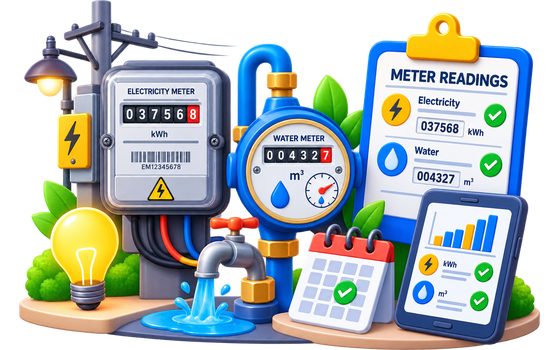
Water, power and gas meters read on the walk-round. Consumption is worked out as the reading is entered and priced at that day's tariff, so correcting an old number never restates a bill already sent.
Utilities
Tank levels, pumps and sensors report on their own device key. Set the thresholds that matter and get an alert when one is crossed — or when a device simply stops reporting.
AutomationThe gate, the fire kit, and what happens when something is late.
A gate register the guard actually keeps, with check-in and check-out. Residents expect a guest from the app and see the visitors logged against their own flat.
Security
Shift attendance marked at the post — a guard marks their own — with summaries for whoever signs the security bill at the end of the month.
Security
Whose car is this? The guard types the plate as it is painted on the bumper and the register matches however the resident typed it — TS 09 AB 1234 and ts09ab1234 are the same car. Bays are allotted to a flat or pinned to one vehicle, so “somebody is in my slot” has an answer.
Gate
A fire, an entrapment, a theft — recorded when it happened, not when someone got round to it. Anyone in the society can report one; the investigation, root cause and corrective job follow.

Safety
Every extinguisher, hose and alarm with its refill and hydro-test dates. Inspections snapshot the kit, the inspector marks pass or fail, and a failure raises the work order on the spot.
Compliance
Set response and resolution targets by category and priority. Work orders and complaints are both measured against them, so "we'll look at it" has a clock on it.
Service levels
Define who hears about it after how many hours overdue — the assignee, then the committee, then the owner. Each level fires once, and anyone can escalate by hand.
Service levels
Lodge, assign, resolve and close, with the resident who reported it kept in the loop. Whoever runs the complaints desk is a role of its own, separate from allocating technicians.
Residents
The plumber, the electrician, the lift company. Rated by the people who used them, and open to everybody working in the building.
DirectoryDues in, bills out, and a paper trail for both.
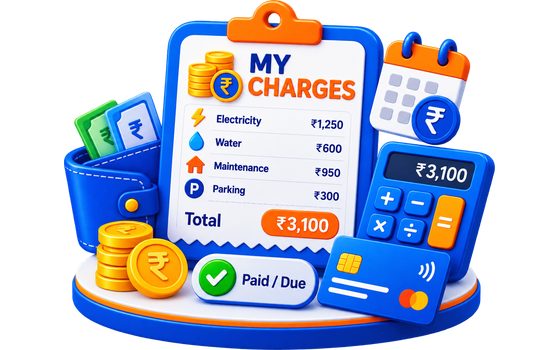
Recurring maintenance charges raised per flat, payments recorded against them, and a receipt PDF generated and emailed to the resident whose dues they are.
Finance
Residents pay their dues from the app by card or UPI. Each society uses its own payment account and its own bank, so the money lands where the society already banks — and a signed webhook, never the phone reporting success, is what settles a payment.
Finance
The society's own bills, part-paid or in full, each producing a payment voucher showing the total and what is still outstanding — the question a treasurer actually has.
Finance
The society's accounts kept where its money is recorded, so the treasurer who holds the banks is the same person the responsibility was handed to — not whoever happens to be an admin.
Finance
A tenancy per flat with rent, deposit and due day. What is owed is derived from the due dates that have passed, so an advance or a late payment still lands in the month it covers.
Landlords
Ticking in the housekeepers, guards and technicians, then a payroll run computed from it — draft, approved, paid. Marking the register is ordinary committee work; approving what somebody is paid is deliberately not, and they are two separate rights.
HR
Who the society employs, with designation, department, salary and bank details. Kept apart from the pay run, because keeping the register is a standing job and a run happens once a month — and the money on it is visible to the owner, an admin, or somebody named to payroll and nobody else.
HR
Next year’s figures argued over at the AGM, and what has actually been spent against them. A responsibility of its own rather than one riding on the bank accounts — the plan and the place the money actually sits are two different things, and often two different people.
Finance
A resident’s own ledger: what they have paid, the receipt for each payment, and what is still outstanding. Including the awkward case — money the gateway captured that never reached the charge. The app says so, tells them not to pay it twice, and gives them the reference to quote.
ResidentsThe screens that show you the whole building at once, and the record of what was done to it.
One screen for what is wrong here that you are answerable for — unpaid dues, open complaints, overdue jobs, contracts lapsing, stock run out, visitors still inside from yesterday. Every group you do not run is narrowed to your own, so a resident’s version is short and a manager’s is the building’s.
Oversight
Everything waiting on your signature, oldest first, across the five workflows that have one. Each row carries the endpoint that already owns the act, so this is a queue rather than a second place a bill can be approved from.
Oversight
Six diaries in one: meetings, lift servicing, the clubhouse, fire checks, bill due dates and the housie night. Each entry is gated by the rule its own screen applies, so the calendar never shows somebody something they could not have opened anyway.
Oversight
The whole facility in one screen — what is overdue, what is unpaid, what is waiting on a signature — with the server deciding what counts as red.
Insights
Twelve months of collection rate, complaint closure time, spend by category, occupancy, visitors and maintenance load. A month in which nothing was billed has no collection rate and is drawn as a gap — nought would be a claim about the society rather than about the data.
Oversight
Who did what to the society’s money, its accounts and its roles — written as part of the act rather than alongside it, and with no endpoint that can write to it at all. Account numbers and gateway secrets are dropped by name before anything is stored.
RecordsBooking the shared spaces, the Saturday housie, and money between neighbours rather than the society’s.
Housie for the whole society or for eight friends. Tickets are cut when the game is created, the server draws the numbers, and every claim is checked against the call log — not against what a player marked.
Games
The clubhouse, the gym slot, the guest room. The gym takes fifteen at a time in hourly slots and needs nobody’s permission; the hall takes one party and the committee says yes. A pending request holds the slot, so two families are never both promised Saturday.
Amenities
Flatmates, a trip, a party. One net figure per person rather than a matrix of who owes whom, and a suggested set of payments when everyone wants to square up.
CommunityNot sure which of these your society needs? Tell us how you run the place and we'll show you the ones that fit.
Any system can list features. These are the ones a committee notices in the second month.
Each society collects into its own account through its own payment gateway — nothing pools anywhere in between. Credentials are encrypted at rest and never sent back to any device. Every payment leaves a receipt, and anything the gateway took that the books missed is flagged for you to apply.
The gate house is usually the part of the building with the least reception. The visitor register and the screens around it keep opening from a saved copy — stamped with the time it was taken, never dressed up as live, because a guard acting on a stale list is worse than one seeing an error.

English, हिन्दी, తెలుగు, தமிழ், ಕನ್ನಡ and മലയാളം, chosen per person rather than per building — one handset per household is normal. Amounts are grouped the way they are read here: ₹1,23,456, not ₹123,456.


Not "admin or not". Thirty-two areas a role can be handed: a treasurer who keeps the banks and the bills, a secretary who keeps the minutes, a guard who keeps the register and nothing else. Salaries and gateway credentials stay with the owner, whatever else is ticked.
The register of flats and who lives in them is the one source. Charges, rent, parking bays, the resident directory and the ballot all read from it — so there is no second list to fall out of step, and no month spent working out which one is right.
Work orders, housekeeping rounds and complaints carry a review and sign-off trail, and payments keep every outcome — including the failures. When somebody asks in March what happened in October, there is an answer.
No complex setup. No training required. Your society can go live within a day.
Create your facility profile with blocks, units, and society details. We handle the onboarding.
Send invites to flat owners and tenants. They download the SAC app and join their unit.
Set up charge schedules, assign committee roles, and enable the modules your society needs.
Start managing visitors, collecting dues, and resolving complaints — all from one app.
Whether you're a small gated community or a large township, we'd love to show you how SAC can simplify your management.
Browse common questions or reach out to our support team. We're here to make sure your experience is seamless.
Setup, navigation, and feature walkthrough for residents and admins.
How charges are calculated, payment methods, and receipt downloads.
Password resets, role permissions, and data privacy settings.
Troubleshoot connectivity, login errors, and notification problems.